Guide page
Introduction

Introduction
Building Stronger Communities. Strengthening Democracy. Together.
Municipal elections matter because local decisions shape our everyday lives. The people elected to municipal council make decisions about local roads and transit, housing and neighbourhood growth, parks and recreation, water and waste services, emergency services, taxes, budgets, and the many other services that help communities thrive.
Municipal elections are an opportunity for people to choose the local leaders who will represent them, make decisions on their behalf, and advocate for their community.
But too many people feel disconnected from local politics or are unsure how voting relates to the things they care about most. In the 2022 Ontario municipal elections, only 32.9% of eligible voters cast a ballot.
This is where community organizations and local leaders can make a real difference.
You know your community. You understand the concerns, hopes, and challenges people are facing. You may be one of the first places people turn when they need information, support, or someone who will listen. By creating a welcoming opportunity for people to talk about what matters to them and learn about voting, you can help make local democracy more accessible, relevant, and meaningful.
When you run a Vote PopUp, you help people see the connection between the issues they care about and the local leaders they elect. You help make sure that more people have the information, confidence, and opportunity to use their voice in the upcoming election.
- “When we heard about Vote PopUp, I knew it was needed in our community… voter turnout in the neighbourhoods we work in is lower than most of the city. In my experience there is… fear in voting for the first time… it’s difficult to think that your vote will matter… voter education is needed.”
- Kyara, North York Harvest Food Bank

About Vote PopUp
Vote PopUp is a welcoming, hands-on, non-partisan activity that helps people feel more confident about voting. It brings a simulated voting experience into familiar community spaces such as libraries, community centres, campuses, food banks, settlement agencies, housing communities, neighbourhood events, and programs for youth, newcomers, seniors, and families.
Rather than beginning by telling people they should vote, Vote PopUp begins with a simple question:
What matters to you?People may talk about housing, jobs, safety, transportation, parks, childcare, affordability, access to services, the environment, or something else entirely. The goal is not to tell people which issues should matter. The goal is to create space for people to identify what matters in their own lives, their families, and their communities.
From there, Vote PopUp helps participants make the connection between their concerns and the local leaders who make decisions that affect those concerns.
How Vote PopUp Works
A Vote PopUp is built around listening, learning, and participation.
Listen
Identify the issues that matter most to participants.
Learn
Understand how municipal leaders and local government affect those issues.
Participate
Practise voting, ask questions, and build confidence to participate.
Through this process, Vote PopUp helps people identify the issues that matter most to them, understand local government, feel more comfortable with voting, learn where and when they can vote, and build confidence to participate.
- “I have two young kids, ten and six years old. They voted with me this weekend. I want them to live in a world where they feel like contributing members of society. Civic engagement reinforces our ties to one another.”
- Ali Haafir, Canada-Muslim Vote

How to Use This Guide
This guide gives you the tools you need to plan and run a Vote PopUp in your community.
- Practical guidance for preparing, running, and following up after a Vote PopUp.
- Easy-to-use activities that make learning about voting engaging and welcoming.
- Scripts for running a Vote PopUp in a public space or as part of an existing program.
- Information to help participants understand municipal elections and voting.
- Resources to help people prepare to vote, including voter identification and local voting options.
You do not need to be an elections expert. The most important thing you bring is your relationship with the community and your commitment to creating a space where people feel welcome, respected, and heard.
- “You have really opened my eyes about things. I thought I had no issues, so I didn’t pay attention! I’m going to pay more attention to what the candidates say about things from now on.”
- Vote PopUp participant, TAIBU Community Health Centre

Vote PopUp Core Principles

Keep It Non-Partisan
Vote PopUps welcome everyone. They do not promote or oppose any candidate, political party, or position. Being non-partisan helps create a space where people can speak openly about their concerns, ask questions, and learn about the election without pressure or judgment.
The focus is on the issues people care about and helping them make their own informed choices.
Start by Listening to What People Care About
Vote PopUps begin with people’s lived experiences, priorities, and hopes for their communities. When you ask people what matters to them, you invite them to see that local democracy is about more than an election day. It is about having a say in decisions that affect their lives.
When you listen, you show people that their concerns are worth hearing. When more people have the confidence and opportunity to participate, communities become stronger, more representative, and better able to shape their shared future.

How to Organize a Vote PopUp
Organizing a Vote PopUp involves three phases.

Step one
Preparing the Activity
Choosing Vote PopUp Dates
Vote PopUps can be held any time before Election Day. Ideally, hold yours far enough in advance that participants have time to learn about the issues and candidates, gather their ID and proof of address, and plan their journey to their voting location.
Prepare Your Materials
What Is Included in Your Toolkit?
- Organizer Guide — Digital downloadable resource
- What Matters and Why Vote Posters
- Voting Screen
- Ballot Box
- Copies of Practice Ballots
- I AM A VOTER Stickers
Add your municipality’s when, where, and ways to vote information into the Vote PopUp scripts (there’s one for doing a Vote PopUp in a public place and one for doing a Vote PopUp in a program).
What Else Will You Need?
- Order a free Vote PopUp toolkit at engagedemocracy.ca at least two weeks before your event.
- Signs, pens or pencils, your municipality’s voting handout, and a list of local candidates for reference.
- Colourful markers and large sticky notes for the posters.
- Optional food or other incentives.
- A computer with internet access, information about all-candidate forums, and non-partisan candidate guides.
- “The resources were fantastic. The materials drew attention and provided [necessary] information. We spoke about the importance of voting and having a voice for things that are important to you. The initiative raised awareness to people of all ages that voting is both simple and important, all by youth who have never voted before.”
- Cecelia, Mississauga YMCA Youth Advisor
Choose a Location
Go Where People Meet in Your Community
The ideal Vote PopUp has a steady flow of people who have never voted or do not usually vote. You can find them within an existing program or in a public place. If you are outside, prepare for the weather, including wind.
Every Vote PopUp has at least one voting station where 20–30 people an hour can practise voting. With two more team members for each station, you can set up more voting stations.
Choose a Place Where You Can Set Up
A wall or easels for posters, a couple of tables, and a clear agreement with staff at the location that you are a local non-partisan community group educating people about when, where, and ways to vote.
For assistance, contact the.exchange@torontomu.ca.
Put Together Your Vote PopUp Team
Vote PopUps are about talking to people about what matters to them. That takes a team of people willing to ask questions and listen. Everyone from teenagers to seniors can have fun and help out. People do not need to be eligible to vote or be election experts. Some of the best volunteers have been teenagers and community members who are not yet citizens.
A voting station can be run by two to four people. You need two extra people for each voting station you add. The team can include staff or board members from community groups, friends and family, and volunteers. They carry out voting procedures and answer questions about when, where, and ways to vote.
If you or your organization needs help with staffing a Vote PopUp, please reach out to us. We may have staff or volunteers who can assist.
You are now all set for Vote PopUp. Remember, your role is not to be an expert on elections — that is the job of your municipality’s Municipal Clerk. Every municipality has one, and they are in charge of running the election. They are the experts on where, when, and ways to vote, how to apply for election jobs, and whether you are eligible to vote.
Find your Municipal Clerk on your municipality’s website or at its office.
Many municipalities produce handouts about voting that you can use at your Vote PopUp. Contact your local Municipal Clerk to request them.

Step two
Run the Vote PopUp
Meet With Your Team and Assign Roles
Do a quick rehearsal so everyone feels comfortable with the activity and knows who will welcome participants, run the voting station, answer questions, and photograph the activity with permission.
Set Up
Materials checklist
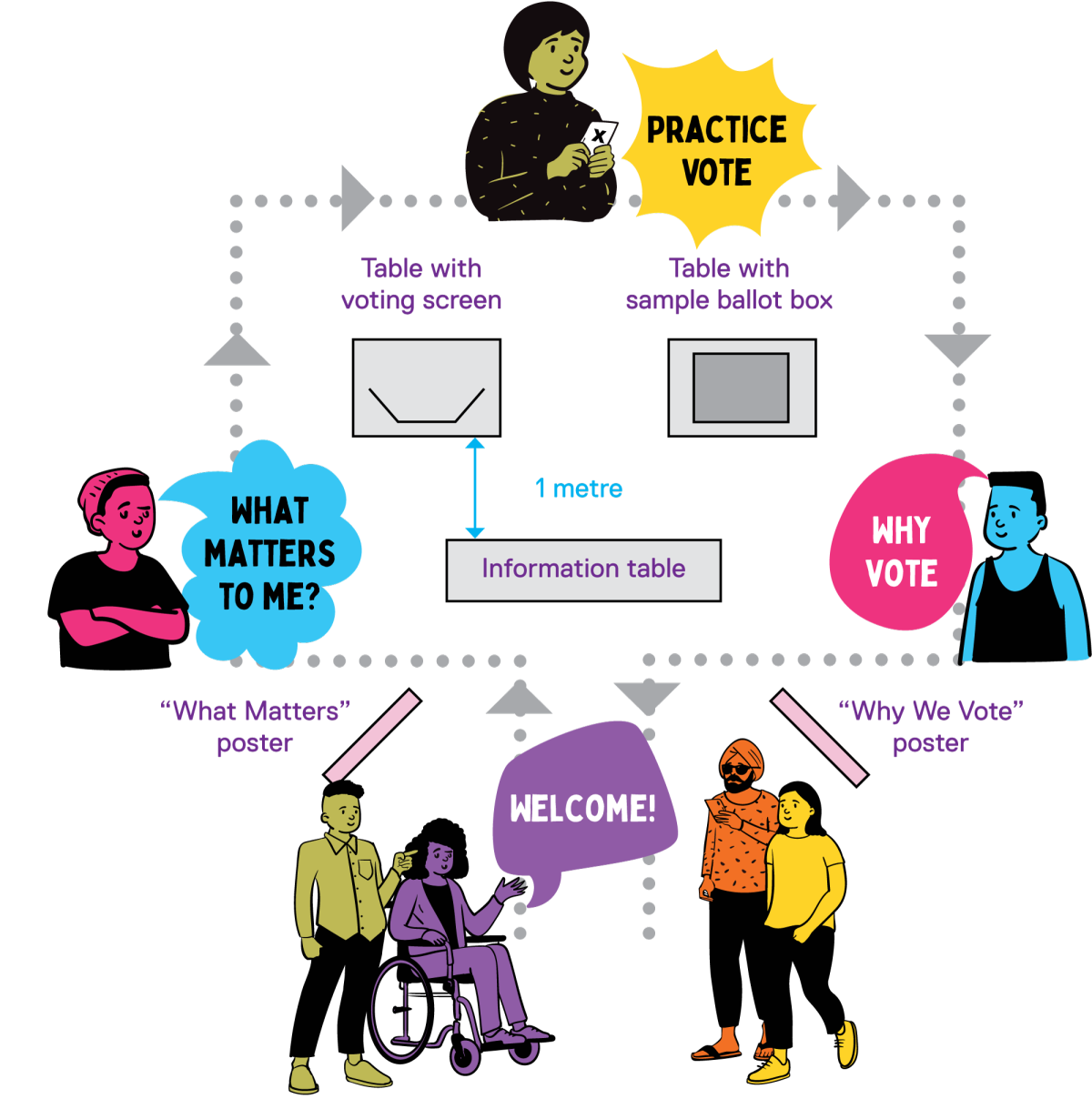
- A table with the voting screen behind the information table, providing as much privacy as possible.
- Easels or a wall for the “What Matters” and “Why We Vote” posters.
- A ballot box on a small third table or one end of the information table.
- Signs, pens or pencils, the municipality’s early, in-person, and at-home voting handout, and a candidate list.
- Colourful markers, the Vote PopUp toolkit, and optional food or other incentives.
- A computer with internet access, information about all-candidate forums, and non-partisan candidate guides.
Running the Vote PopUp
The activity has three steps and usually takes three to ten minutes.

FIRST
Ask people what matters to them and listen.

SECOND
Help people practise voting and answer any questions they have.
THIRD
Ask participants why they think voting is important to them.
This process will take participants three to ten minutes, depending on the number of questions they have.
When you run a Vote PopUp, you’re doing something really meaningful to build community. People know their own lives and what they need. And yet, most people are never asked for their opinion. Too many feel their voices don’t count. When you ask people what they care about and really listen – you are making change. You’re inviting people to share their opinions, use their voices, and practise voting. You’re inviting them to shape the decisions that impact their lives.
We have provided a Vote PopUp script to guide you through the activity, whether you are in a public place or in a program. Have fun!
Don’t start by asking people:
- If they plan on voting in the upcoming election
- To make sure they vote
- What they think about the candidates
Students Vote!

Scripts
Vote PopUp Scripts
Use these scripts as a guide. Keep the tone conversational, welcoming, and non-partisan. The voter-ID, sample-ballot, and Voting Information Template links in Script 1 also apply to Script 2.
Everyone in Ontario can vote before Election Day, October 26, 2026. And everyone has an option to vote not in person.
Do you still have questions? You can contact our Municipal Clerk this way. Feel free to email the.exchange@torontomu.ca with your questions.
- Have the sample ballots in your hand.
- Take photos of people voting if they don’t mind. It’s a great way to capture the importance of the activity.
- Have lots of colourful markers for people to use.
- Make sure to take pictures of the poster before and after the activity.
- Showing those pictures helps to tell others about the movement.
All of these materials are important because they reflect community opinions and show people using their voice.
Make sure to keep them for a future installation so anyone can see what you have done.
It shows the importance of participating in democracy, and it shows people in the community shaping their future.
Write down people’s answers on post-it notes.
For example: housing, schools, transit or parks.
Script 1: Vote PopUp in a Public Place
Step 1: What Matters to People
Hi! My name is ___________ and I’m with _______________ (community group). We are here today finding out what our community cares about.
What matters to you? What’s important to you in your life? For your family? For the community?
I’m only here to listen. Your opinion matters. Every voice counts.
That’s why I’m writing down your answers. On this wall, we are posting everyone’s answers so everyone can see what’s important to people in the community.
Governments make decisions about these things on behalf of all of us. Do you want to practise voting with us?
Other useful things to mention
- I don’t work for a candidate.
- This activity will take just a few minutes.
- It’s a great way to practise for the actual election.
- Please have some food or whatever you are offering.
- Kids are welcome to join their parents.
- Stand in a prominent place.
- Write down people’s answers in 1–3 words for every post-it note, for example: housing, schools, transit, or parks.
If they say yes
If they say they are already planning to vote
Then invite them to write why voting is important on the “Why We Vote” poster.
If they say they do not have time
It will only take a couple of minutes. We’re not working for a political party, and we don’t want to convince you to do anything. And we have food and stickers or other goodies!
If they still say no
Thank you — and don’t forget to vote!
If they say voting will not make a difference
I understand. Many people I know feel that way. What matters to you in your own life? What are you concerned about?
Stop to listen.
If they say they do not trust voting or elections
I get it. It’s the job of the independent town or city clerk to ensure that elections are free and fair. They work for your community, not for any candidate. If you have questions or concerns, call them. They are there to help you.
Step 2: People Experience Voting
Welcome to the voting table! Here, we will talk about when, where, and ways to vote. Keep the handout that gives you all the information you need to vote in our municipality.
If you have a driver’s licence with your current address, you are all set. If not, photo ID is not required. You can use many documents that show your current address, including a lease, insurance policy, credit card statement, utility bill, or post-secondary transcript.
These resource destinations are placeholders until the corresponding files are supplied. Replace the links above with the approved voter-ID list, sample ballot, and voting-information template.
Each municipality has its own rules about where, when, and ways to vote. Complete the Voting Information Template for your own municipality.
- Have the sample ballots in your hand.
- Take photos of people voting if they don’t mind. It’s a great way to capture the importance of the activity.
In our municipality
On Election Day, you can vote these ways: [REFER TO YOUR COMPLETED SHEET]
You can vote early on these dates: [REFER TO YOUR COMPLETED SHEET]
You can vote early in these ways: [REFER TO YOUR COMPLETED SHEET]
Questions? Contact your Municipal Clerk: [INSERT MUNICIPAL CLERK CONTACT INFORMATION]
Step 3: People Share Why Voting Matters
Your last step is to write why you think voting is important on this poster. We will be sharing the results, so please come by again to see what the community says.
I really want to encourage you to do the activity. You can use these large sticky notes. Please write in whatever language you are most comfortable with. If you would like, I would be happy to write it down for you.
- Have lots of colourful markers for people to use.
- Make sure to take pictures of the poster before and after the activity.
- Showing those pictures helps to tell others about the movement.
Script 2: Vote PopUp in a Program
Step 1: Introduce the Activity
Remind people that there are municipal elections coming up on October 26, 2026. Explain that today everyone will share what issues are important to them, practise voting, and say why they think voting is important.
Note: Everyone can participate even if they are not yet eligible to vote. To be eligible to vote in Canadian elections, you must be at least 18 years old, a Canadian citizen, and a resident or own property or be the spouse of someone who owns property in a municipality.
Step 2: What Matters to Program Participants
Today, we are going to talk about what you care about. We are going to line up and go through three steps. Join me here for the first step, which is to think about what matters to you. What’s important to you in your life? For your family? For the community?
Your opinion matters. That’s why we are all going to write down the answers. Just one to three words for every post-it note. We are posting everyone’s answers on this wall. Governments make decisions about these things on behalf of all of us, so we are also going to practise voting.
Other useful things to mention
- I don’t work for a candidate.
- This activity will take just a few minutes.
- It’s a great way to practise for the actual election.
- Please have some food or whatever you are offering.
- Kids are welcome to join with their parents.
Write down people’s answers on post-it notes, such as housing, schools, transit, or parks.
Step 3: People Experience Voting
Welcome to the voting table! Here, we will talk about when, where, and ways to vote. Make sure to keep the handout that gives you all the information you need to vote in our municipality.
Ask if they have a driver’s licence with their current address. If yes: “You are all set and should take your ID when you go to vote. Please go to the voting table.” If they are not sure, explain that photo ID is not required and that many documents can prove their address. Use the resource links and municipality-specific template above.
Everyone in Ontario can vote before Election Day, October 26, 2026, and everyone has an option to vote not in person.
Marking the Vote PopUp Ballot
Can I show you the practice ballot and how to mark it? You fill in the ballot here. Mark your ballot by filling in the circle next to your choice for Mayor, Councillor, and School Trustee. You can also put an X or checkmark there. Don’t worry — what counts is your intention.
Please go behind the voting screen to cast your ballot. Then fold and place your ballot in the voting box. You can take a selfie while you practise here, but not when you vote in the election. Just one more step left.
Organizer reminder: Have sample ballots ready and take photos only when people are comfortable with it.
Step 4: People Share Why Voting Matters
Your last step is to write why you think voting is important on the “Why We Vote” poster. We will be sharing the results, so please come by again to see what the community says. Offer assistance, large sticky notes, and colourful markers. Participants may write in whatever language they are most comfortable with.
Step three
After the Vote PopUp
After the Vote PopUp, you have played a crucial role in removing barriers to democratic participation. You have shown community members that their voices and opinions count, shared when, where, and ways to vote, and helped people experience voting.
Start by Sharing the Results!
It is important for people to know that community members participated and what matters to them. When people see that they are not alone and others share their concerns, they are more likely to stay involved.
Use #VotePopUp to share photos and comments on social media, including top concerns, people learning about voting and their ballots, and contributions to the “Why We Vote” poster. You may also tag @voicethevote on Facebook or Instagram.
Invite people to complete a short survey after the activity, if your organization has prepared one.
Create an interactive display for your lobby using the posters and handouts about how to vote. Keep the materials for a future installation so people can see what the community has done and how residents are shaping their future.
Plan Your Next Vote PopUp
Now that you have experience, you can repeat the activity and make voting education a regular part of program learning. Start planning well ahead of the election for your next Vote PopUp.
Vote PopUp Has Connected You With the Pulse of Your Community!
- Display “What Matters to Me” and “Why We Vote” posters and photos in a local library or community centre.
- Post photos and people’s reactions on social media.
- Share top priorities with municipal and school board candidates.
- After the election, share top priorities with elected representatives.
- Contact local media to let them know what you are doing and what you have heard.
For Your Community-Based Organization
Vote PopUp is like research on what people care about most. Display the posters and photos, bring community priorities into program and policy advocacy plans, and run a Vote PopUp between elections.
Work it: Apply to be part of the team that runs the municipal election in your community. Contact your municipality to find out how.
Get involved in your municipal government: Join a municipal agency, board, or commission in your community.
Get involved in your school or school board: Parents can join School Advisory Councils and board committees. No election required!
FAQs Related to Vote PopUps
When should I hold a Vote PopUp?
Vote PopUps can be held any time before Election Day. Hold yours early enough for participants to gather ID, learn about the issues, and plan their journey to vote.
How many people do I need?
The size depends on the location and expected participants. For about 30 people per hour, plan for at least two to three people, plus outreach support in a public space.
What does it cost?
It is free to run a Vote PopUp. The usual costs are photocopies and optional refreshments. The toolkit can be ordered free from the Democratic Engagement Exchange.
Who can participate?
Anyone can participate, regardless of age, citizenship status, or political interest.
Why are Vote PopUps non-partisan?
Remaining non-partisan helps everyone feel welcome and keeps the focus on learning and practising voting rather than endorsing a candidate or party.
What if I do not have Internet access?
Internet is recommended but not required. Participants can contact their municipality or use a smartphone to check voting times and locations.
FAQs Related to the Election
Why can some people vote in more than one municipality?
If you are a Canadian citizen and 18 years of age or older, you may be able to vote in more than one municipal election. You can vote where you live, where you own or rent property, where your spouse owns or rents property, and, as a college or university student, where you live while attending school and where you live when not in school.
What ID do I need to vote?
You only need to prove where you live. A driver’s licence or another official document showing your current address can work, including utility bills or a post-secondary transcript. See the Voter ID section below.
Why should we put our trust in the election?
When you vote, you put faith in yourself and your community and show that your community matters. It is the job of the independent town or city clerk to ensure that elections are free and fair. They work for your community, not for any candidate. If you have questions or concerns, contact them.
Who decides what municipalities and school boards do?
The Ontario provincial government defines what municipalities and school boards must and cannot do. If municipalities or school boards do not obey the law, they are breaking the law.
How do I choose a school board for my trustee vote?
You may choose English public, English Catholic, French public, or French Catholic. No matter which school your children attend, you are automatically eligible for the English-language public school board unless you change your support. MPAC maintains the provincial school-support record. Visit MPAC contact information for help. You cannot change your school support when you go to vote.
Why do some places allow internet and telephone voting and not others?
Every municipality can set its own rules, within limits, about where, when, and ways to vote. If you do not like the options available, talk with your local representative and Clerk’s office.
Voter ID: So Many Options!
Examples of ID include:
- Ontario driver’s licence
- Ontario health card, if your name and address are printed on it
- Mortgage, lease, or rental agreement
- Insurance policy
- Credit card statement
- Bill for hydro, water, gas, telephone, or internet, including one on your phone
- Transcript or report card from a post-secondary school
A Canadian passport is not an acceptable identification document because you write your address inside your passport yourself.
Acknowledgements
Vote PopUp was made possible by support from United Way Greater Toronto and the Association of Municipalities of Greater Toronto.
Vote PopUp is part of the 2026 Voice the Vote project. Voice the Vote helps you use your voice, cast your vote, and shape your community in the municipal election on October 26, 2026. Through community events, grassroots micro-grants, leadership training, and educational resources, Voice the Vote invites you to get informed, get involved, and make your voice heard.
Vote PopUp was initially created by The Samara Centre for Democracy. Toronto Metropolitan University and the Democratic Engagement Exchange are deeply grateful for The Samara Centre’s support and continued commitment to building a stronger democracy for all Canadians.
Thank you to Nancy Close and the team at VoteKit Calgary, the Faculty of Arts at Toronto Metropolitan University, and all the community organizations and civic leaders across the country for contributing their time and talent.
For more information, visit engagedemocracy.ca.
Credits
The Democratic Engagement Exchange drives engagement by building partnerships with academic institutions, community organizations, and government agencies to create tools and champion policies and programs that promote a more inclusive democracy.
Copyright © Toronto Metropolitan University, 2026
Publisher: Faculty of Arts, Democratic Engagement Exchange
Lead writer: John Beebe
Designer: Randal Boutilier at 12Thirteen Design